
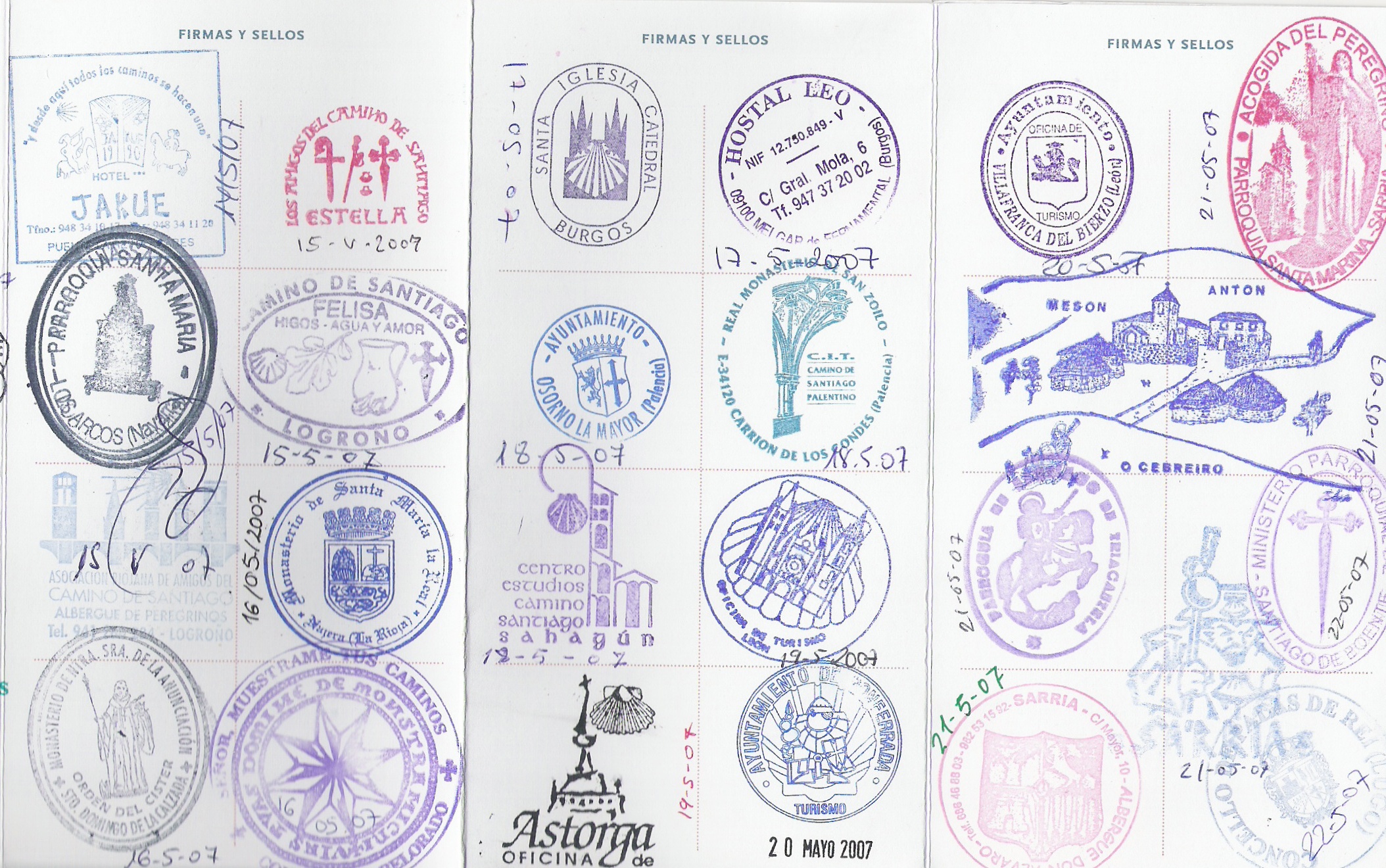

Most pilgrims have a document called the credencial, which they have purchased for a few euro's through a Spanish tourist agency or their local church, depending on their starting location. I got mine and Dave's from the St. James association of the Netherlands. The credencial is a pass which allows (sometimes free) overnight accommodation in refugios. Also known as the "Pilgrim's passport", the credencial is stamped with the official St. James stamp of each town or refugio at which the pilgrim has stayed. It provides the pilgrims with a record of where they ate or slept, but also serves as proof to the Pilgrim's office in Santiago that the journey is accomplished according to an official route. The credencial is available at refugios, tourist offices, some local parish houses, and outside Spain, through the national St. James organisation of that country. The stamped credencial is also necessary if the pilgrim wants to obtain a compostela.
Most often the stamp can be obtained in the refugio, Cathedral or local church. If the church is closed, the town hall or office of tourism can provide a stamp, as well as nearby youth hostels or private St. James addresses. Outside Spain, the stamp can be somewhat of a ceremony. As the pilgrimage approaches Santiago however, the increased number of pilgrims cause many of the stamps in small towns to be self-service, while in the larger towns there are several options to obtain the necessary stamp.
The Compostela is a certificate of accomplishment given to pilgrims on completing the Way. To earn the Compostela one needs to walk a minimum of 100 kilometers (cyclists must cycle at least 200 km). In practice for walkers, that means starting in the small city of Sarria, for it has good transportation connections via bus and rail to other places in Spain. Pilgrims arriving in Santiago de Compostela who have walked at least the last 100km, or cycled 200km to get there (as indicated on their credencial), are eligible for this Compostela from the Pilgrim's Office in Santiago.
In medieval catholicism, the "Compostela" counted as an act of indulgence. The bearer was entitled to a reduction by half of their time in purgatory, or, if the Compostela was obtained in a Holy Year, a full indulgence. The full text of the certificate is in Latin and reads:
CAPITULUM hujus Almae Apostolicae et Metropolitanae Ecclesiae Compostellanae sigilli Altaris Beati Jacobi Apostoli custos, ut omnibus Fidelibus et Perigrinis ex toto terrarum Orbe, devotionis affectu vel voti cosa, ad limina Apostoli Nostri Hispaniarum Patroni ac Tutelaris SANCTI JACOBI convenientibus, authenticas visitationis litteras expediat, omnibus et singulis praesentes inspecturis, notum facit : (Latin version of name of recipient)
Hoc sacratissimum Templum pietatis causa devote visitasse. In quorum fidem praesentes litteras, sigillo ejusdem Sanctae Ecclesiae munitas, ei confero.
Datum Compostellae die (day) mensis (month) anno Dni (year)
Canonicus Deputatus pro Peregrinis
The pilgrim passport is examined carefully for stamps and dates. If a key stamp is missing, or if the pilgrim does not claim a religious purpose for their pilgrimage, the compostela may be refused. The Pilgrim office of Santiago awards more than 100,000 compostela's per year to pilgrims from over 100 countries.

No comments:
Post a Comment